Field notes
GPT-6 Astra: And That Is Supposed to Be AGI?
GPT-6 Astra is a very powerful model. It is just not the revolution that OpenAI's packaging sells you. Notes from brownfield use: ARC-AGI harnesses, independent benchmarks, and price.
I have been running GPT-6 Astra in brownfield projects. After a few days I want to say what convinced me and what did not. The short answer: it is a very powerful model. It is just not the revolution that OpenAI's packaging sells you.
This is not an accusation. It is an observation. And it says something about the way we have been measuring these leaps.
What OpenAI Promised
OpenAI released GPT-6 Astra on September 3, 2026. The training run was the largest OpenAI has ever done: over 100,000 H100 GPUs at the Stargate site in Texas. The official claim was "the world's most intelligent and aligned model." Greg Brockman at the press briefing said we are probably already in the AGI era. Three days after the launch, Nvidia CEO Jensen Huang took it one step further on X:
"GPT-6 Astra, trained on ~100K+ NVIDIA Grace Blackwell NVLink72. From ChatGPT to o1 to Astra in 4 years. AGI has arrived. Congratulations @OpenAI team. 400K GPUs coming online next."
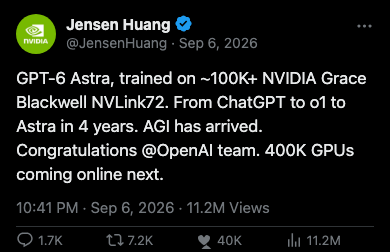
Source: Jensen Huang on X, September 6, 2026
Sam Altman later called the word itself "an irrelevant marketing term." The irony needs no explanation: the man who built the GPUs says AGI has arrived; the CEO who shipped it calls AGI a meaningless marketing word. The promised strengths were computer use, mathematics, cybersecurity, and polished office work. "Anything you can do on a computer, Astra can do for you. Fast" stood on the official page.
The Benchmarks
Astra has genuinely improved on several benchmarks. The numbers I cite here all come from OpenAI's official announcement.
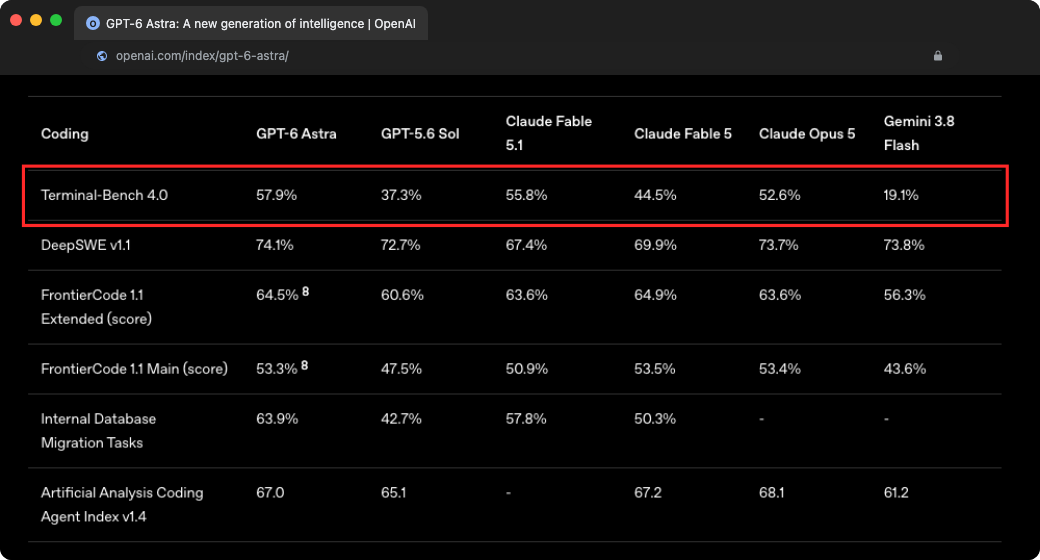
Source: OpenAI's official announcement, highlighted: Terminal-Bench 4.0
Against Sol, Astra wins across the board, usually by a wide margin: 57.9 to 37.3 on Terminal-Bench 4.0, 41.4 to 18.1 on AutomationBench. On OSWorld it is better and faster, scoring 72.6 in 40 minutes where Sol scores 65.7 in 75. Against Fable 5.1 the lead is smaller but consistent: 57.9 to 55.8 on Terminal-Bench 4.0, 64.6 to 52.6 on Terminal-Bench Science.
Astra costs $10 per million input tokens and $50 per million output tokens. That puts it on the same price level as Claude Fable 5.1 and 2.5x above GPT-5.6 Sol.
The Reality
The most contested number is ARC-AGI-3: 99.9 percent. That sounds like AGI.
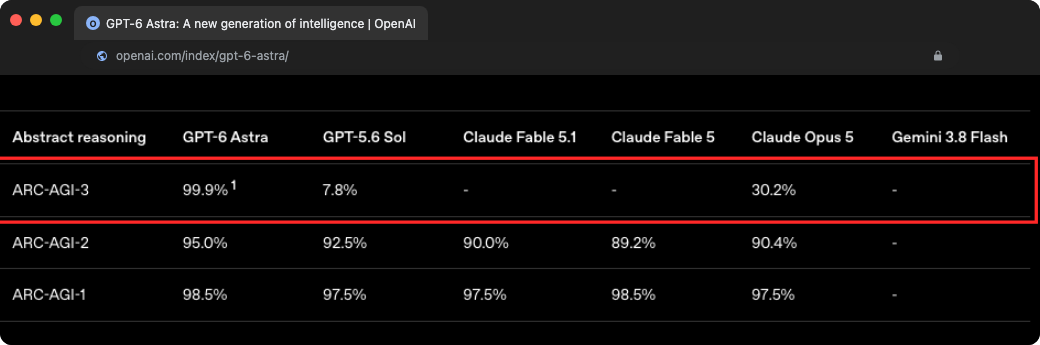
Source: OpenAI's official announcement, highlighted: ARC-AGI-3
It was measured with an OpenAI-specific harness that gives the model capabilities the benchmark does not normally provide. With the standard harness, Astra scores 62.7 percent.
99.9 percent is benchmark gaming. 62.7 percent is a model that does reasonably well but does not reach human parity on most levels. That is the difference between marketing and engineering.
The independent picture does not get friendlier. OpenAI says Astra is SOTA on almost everything. The Artificial Analysis Intelligence Index v4.1.1 says something different.
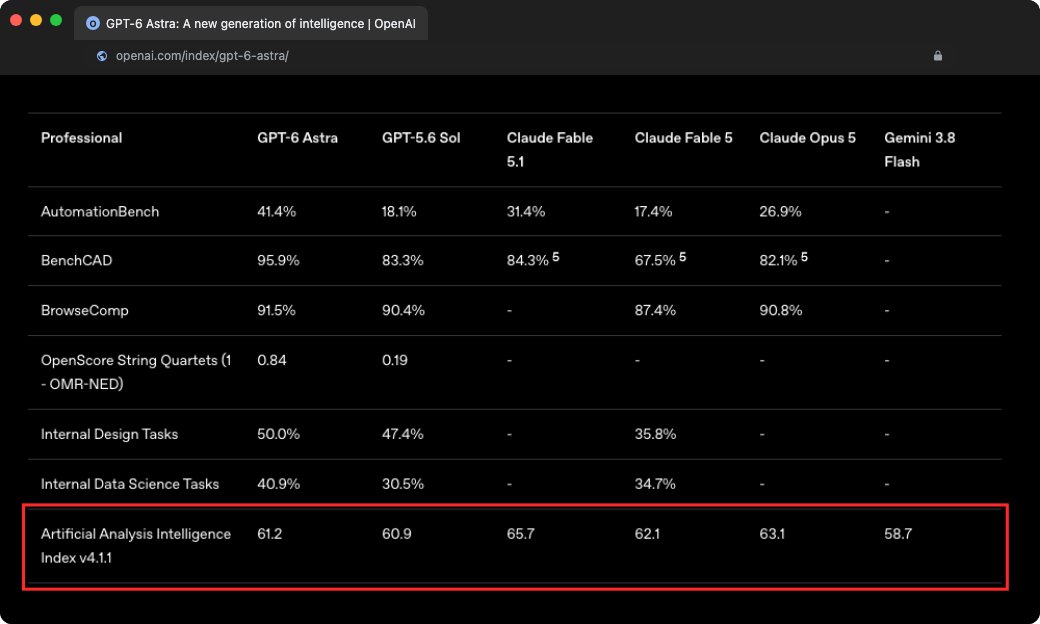
Source: OpenAI's official announcement, highlighted: Artificial Analysis Intelligence Index
On this aggregate measure of agentic work, coding, and reasoning, Astra scores 61.2. Fable 5.1 scores 65.7, Opus 5 scores 63.1, Fable 5 scores 62.1. An independent index, not OpenAI's own framework, puts Astra behind on the core capabilities it is advertised for. That is the most important discrepancy of the entire launch week.
My Judgment
The usual suspects produced spectacular demos within days: a street-by-street Manhattan in Unreal Engine, a browser-based 3D Hangzhou in 24 minutes, a multiplayer shooter in a single day. Super impressive, and almost all of it greenfield. My use case is brownfield. I do not need a Manhattan in Unreal Engine. I need an agent that understands my codebase, writes tests that do not lie, and does not hallucinate pull requests.
Astra is a better GPT-5.6 Sol. Decrypt's early-access testers report that writing quality falls below Sol: about 80 Elo points on an economically valuable professional work benchmark. Pixel-accurate clicking improves while prose gets worse. That is a shifted focus, not general intelligence. OpenAI's own safety overview adds a third trade-off: chain-of-thought transparency decreased relative to GPT-5.6 Sol, with shorter and less informative chains that omit the evidence monitors need.
This is certainly not a bad model. It is a very good model, a very powerful model, possibly on par with Fable or better on some measures. But right now I do not see it as AGI. I see a powerful tool wrapped in packaging that sells you a revolution.
Whether this is a step toward AGI, as Greg Brockman claimed, or a step toward higher API bills, as most engineers think, time will tell. I will continue using GPT-5.6 models. I will use Astra for the hardest tasks, just as I use Fable. For everything else, I rely heavily on my local AI stack: Qwen3.6-35B-A3B, Qwen3.8-27B, and DeepSeek v4 Flash Vision. They are fast, they are cheap, and they are under my control.
Sources used
- Jensen Huang, X post, September 6, 2026: https://x.com/i/status/2096700264569090384
- OpenAI, "GPT-6 Astra: A new generation of intelligence," official announcement, September 2026: https://openai.com/index/gpt-6-astra/
- Decrypt, "OpenAI's GPT-6 Astra Is Shockingly Good at Almost Everything," September 6, 2026: https://decrypt.co/377514/openai-gpt-6-astra-review-shockingly-good
- The New Stack, "Astra ARC-AGI Benchmark": https://thenewstack.io/astra-arc-agi-benchmark/
- Latent Space, "GPT-6 Astra: OpenAI's Biggest...": https://www.latent.space/p/ainews-gpt-6-astra-openais-biggest
- OpenAI, "Safety Overview: GPT-6 Astra": https://openai.com/index/safety-overview-gpt-6-astra/
- Anthropic, "Claude Fable": https://www.anthropic.com/claude/fable
- OpenAI, "GPT-5.6 Sol Model", API docs: https://developers.openai.com/api/docs/models/gpt-5.6-sol